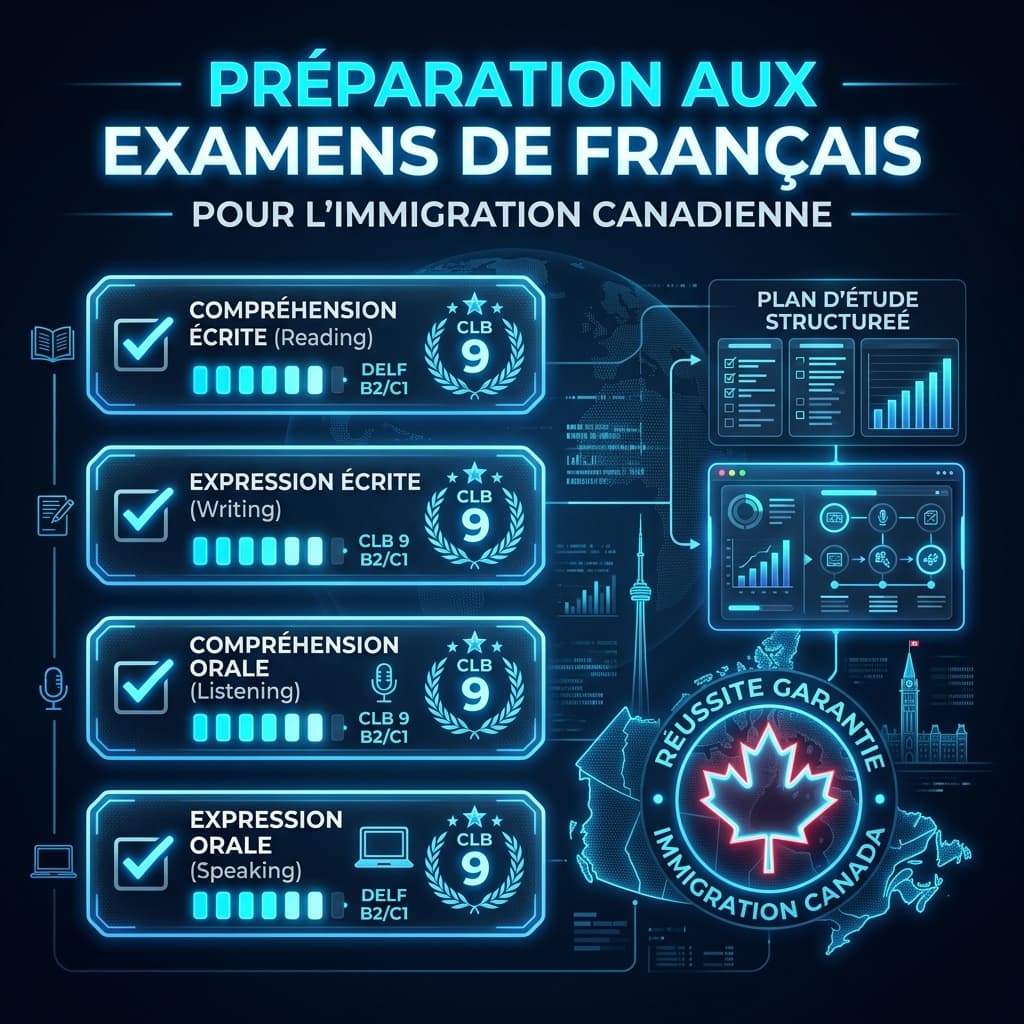
If you're aiming for Canadian Language Benchmark (CLB) level 9 in French, you need to know which TEF Canada scores correspond to it in each skill. French results can add points to an Express Entry profile under the Comprehensive Ranking System (CRS), and many candidates set CLB 9 as their goal. This breakdown shows the score ranges IRCC uses and how to plan your preparation around them.
Key Takeaways
- CLB 9 corresponds to these minimum TEF Canada scores: 248/300 Reading, 298/360 Listening, 371/450 Writing, 371/450 Speaking. Confirm them in IRCC's official equivalency table before you rely on them.
- Each skill is converted to its own CLB level, and Express Entry awards points for each skill separately, so a lower result in one skill means fewer points for that skill.
- TEF Canada is run by the Paris Île-de-France Chamber of Commerce and Industry (CCI Paris Île-de-France).
- Build a study plan around your specific weak section, not general fluency. See our 90-day TEF study plan for a structured approach.
The CLB 9 Score Thresholds
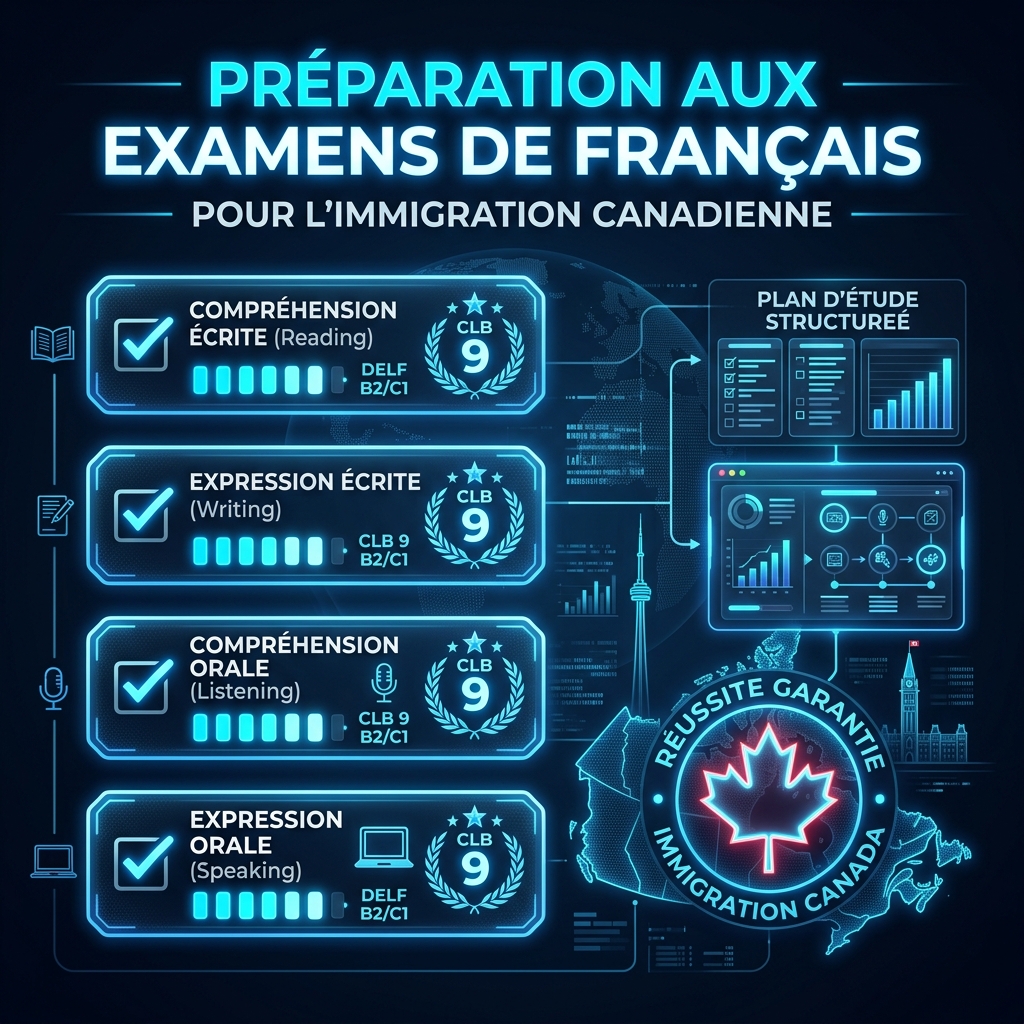
TEF Canada scores Reading out of 300, Listening out of 360, and Writing and Speaking out of 450. IRCC converts each score to a CLB level; these are the minimum scores for CLB 9 in each skill. Equivalency tables can be updated, so check the current one on the IRCC website.
| Section | Minimum Score Required | What It Tests | |---------|------------------------|----------------| | Reading Comprehension (Compréhension Écrite) | 248 / 300 | Analyzing long texts, extracting structural arguments, identifying logic in editorial content | | Listening Comprehension (Compréhension Orale) | 298 / 360 | Quick comprehension of radio announcements, casual dialogues, and complex discussions with varying accents | | Written Expression (Expression Écrite) | 371 / 450 | Section A: a short newspaper article reporting a past event (fait divers). Section B: an argumentative essay arguing a stance on a social topic | | Oral Expression (Expression Orale) | 371 / 450 | Section A: obtaining information about a service or product. Section B: persuading a friend to join a project or activity |
A fait divers is a short, factual news brief with a fixed journalistic structure, distinct from the argumentative-essay format required in Section B of Written Expression. The oral section's two-part structure is independently documented by exam-prep resources outside our own site (TEF Canada Expression Orale format, Rossi ELTS). For a full breakdown of how it's scored, see our Expression Orale guide.
Why Missing Even One Target Hurts Your Profile
Express Entry looks at each skill individually. If you reach CLB 9 in three skills but CLB 8 in writing, you get the points for CLB 8 in writing, and some programs also set a minimum level for every skill. Check the IRCC website for how language results are counted for your program.
<!-- [UNIQUE INSIGHT] -->A common preparation mistake is to focus on the skills you already enjoy and neglect your weakest one. Because every skill is assessed separately, balanced preparation usually serves you better than polishing a section that's already strong.
Hitting these thresholds is as much about avoiding preparation mistakes as it is about knowing the numbers. See our guide to the three biggest French prep mistakes Express Entry candidates make before you start studying.
Not sure TEF Canada is the right test for you? See our TEF Canada vs TCF Canada comparison before you commit to a test date.
Frequently Asked Questions
Do I need CLB 9 in every section, or just an overall average?
Each skill counts on its own. IRCC doesn't average your four TEF Canada scores: Reading, Listening, Writing and Speaking are each converted to their own CLB level, and points are awarded per skill. Check the IRCC website for the minimum levels your program requires.
Which section is hardest to reach CLB 9 on?
It varies by candidate, which is why a diagnostic practice test before committing to a study plan matters more than assuming a section is hard. See our 90-day study plan for how to structure that diagnostic.
This breakdown is based on the publicly available TEF Canada scoring scales and IRCC's equivalency table. Français Pro is independent and not affiliated with the CCI Paris Île-de-France or IRCC. For our editorial approach, see our About page.
Français Pro's exam simulator lets you practise each skill with timed, exam-style tasks and AI feedback on your speaking and writing, so you can see where you stand before test day.