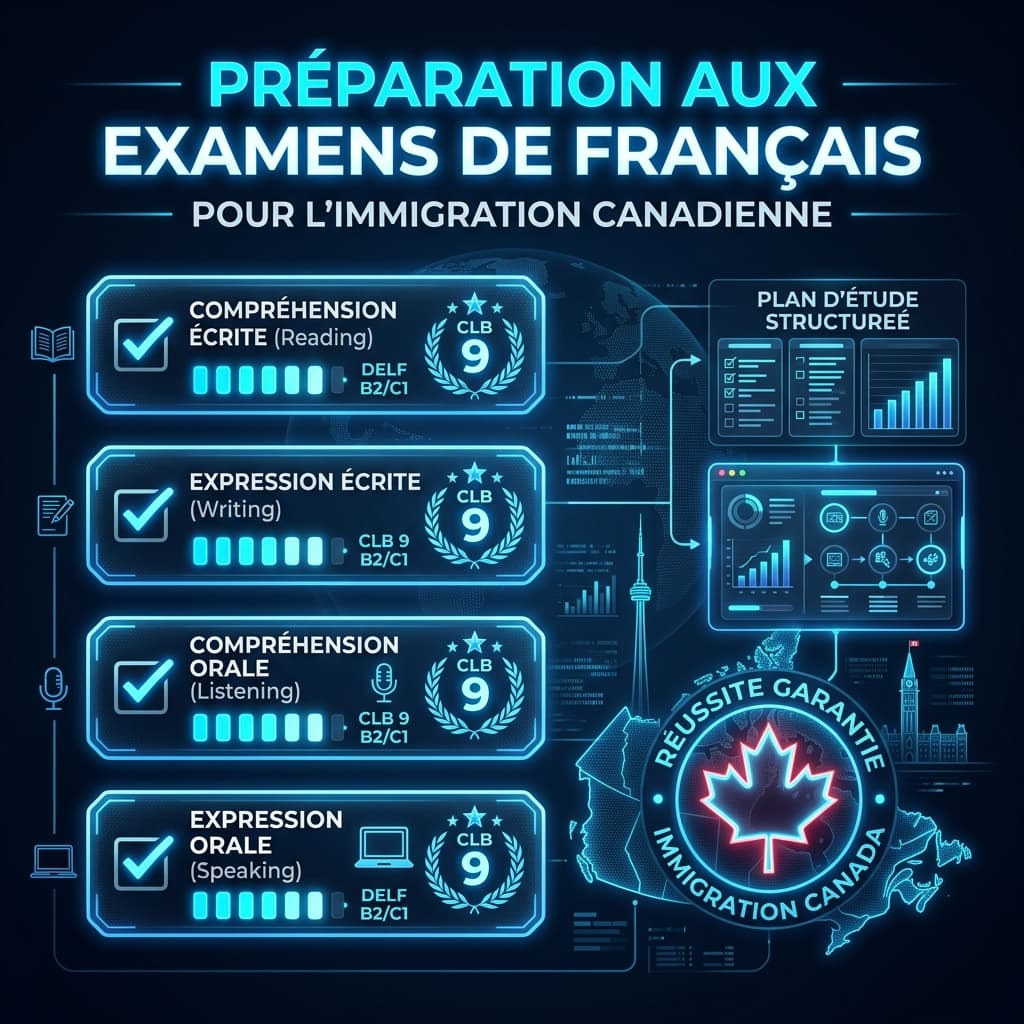
The Expression Orale section is where many Express Entry candidates lose points they didn't expect to lose, not because their spoken French is weak, but because they misunderstand what each of the two sections is actually testing. This guide breaks down Section A and Section B individually, explains how they're scored, and gives you a practice framework you can start using today.
Key Takeaways
- Expression Orale has two distinct sections: Section A is a formal information-gathering interview, Section B is an informal role-play or persuasion scenario.
- Each section gives you roughly 1 minute of preparation time before you speak, so your prep routine should train you to structure an answer that fast.
- Examiners score pronunciation, vocabulary, grammar, coherence, and your ability to justify opinions and adapt to the situation, not just whether your French is grammatically correct.
- To hit CLB 9, you need a minimum Speaking score of 371/450, which means near-consistent strong performance across both sections.
What Does Section A (Expression Orale 1) Actually Test?
Section A is a short, formal interview format, typically 5 to 8 minutes. You play the role of someone requesting information about a service or product from the examiner (TEF Canada Expression Orale guide, Rossi ELTS). The formal register is the entire point of this section. Examiners check whether you can ask precise, polite, and structured questions the way you would in a real administrative or customer-service interaction, not whether you can make small talk.
You get about 1 minute to prepare before the section begins (TEF Expression Orale format guide, French Circles), so your prep needs to be fast, not exhaustive.
Practice framework for Section A:
- Read the prompt and identify exactly what information you need (price, availability, conditions, timing).
- In your 1-minute prep window, list 4-5 concrete questions in order of priority, not a general topic outline.
- Open with a formal greeting and state your purpose in one sentence before asking your first question.
- Use polite conditional forms ("Pourriez-vous me dire...", "Serait-il possible de...") rather than blunt direct questions.
What Does Section B (Expression Orale 2) Actually Test?
Section B is longer, typically 10 to 15 minutes. It shifts to an informal role-play or structured discussion. You must persuade the examiner, such as convincing a friend to join an activity or project (TEF Canada Expression Orale guide, Rossi ELTS). This section rewards a completely different skill from Section A. It tests sustained persuasive argument, not information-gathering.
Practice framework for Section B:
- In your 1-minute prep window, pick your strongest 2-3 arguments rather than trying to list every possible reason.
- Structure your response as: hook (why this matters to the listener) → 2-3 justified reasons → address one likely objection → close with a call to action.
- Practice pivoting when the examiner pushes back. Section B is conversational, so a memorized monologue that can't adapt will lose coherence points.
- Record yourself and check: did you actually respond to what the examiner said, or did you deliver a prepared speech regardless of their reaction?
How Is Expression Orale Scored?
Examiners assess five dimensions across both sections. These are pronunciation, vocabulary range, grammatical accuracy, coherence, and your capacity to express and justify opinions while adapting to the situation (TEF Canada Expression Orale guide, Rossi ELTS).
<!-- [UNIQUE INSIGHT] -->That last dimension, adaptive coherence, is what actually separates a CLB 7 speaking score from a CLB 9 one. It's not enough to speak accurately. You have to respond appropriately to what's actually happening in the conversation, which is why memorized scripts tend to plateau candidates at CLB 7-8 regardless of how grammatically clean their French is.
| Dimension | What it means in practice | Where candidates lose points | |-----------|---------------------------|-------------------------------| | Pronunciation | Clear, intelligible French under exam pressure | Rushing when nervous, dropping liaison | | Vocabulary | Range beyond basic conversational terms | Repeating the same 3-4 adjectives | | Grammar | Consistent accuracy across tenses and structures | Reverting to present tense under pressure | | Coherence | Logical flow, clear structure | Rambling without a clear opening/close | | Adaptability | Responding to what the examiner actually says | Delivering a memorized script regardless of pushback |
To reach the CLB 9 Speaking threshold of 371/450, as detailed in our TEF Canada CLB 9 score breakdown, you need consistent strength across all five dimensions, not just one or two.
A Weekly Practice Structure for Expression Orale
Spread practice across both sections rather than drilling one and neglecting the other. They test different skills, and both count toward the same combined Speaking score.

- 2x per week: Section A drills. Use realistic scenarios (booking an apartment, requesting a refund, asking about a course) and time yourself to a strict 1-minute prep window.
- 2x per week: Section B drills. Practice persuading a partner or recording yourself, then listen back specifically for whether you responded to objections or just talked past them.
- 1x per week: Full timed mock combining both sections back-to-back, to build stamina for the actual 15-minute session.
Avoid the mistake covered in our three biggest French prep mistakes post: casual conversation apps won't prepare you for either the formal register of Section A or the structured persuasion of Section B. Both require deliberate, exam-specific practice.
Frequently Asked Questions
How much preparation time do I get before each section?
Roughly 1 minute per section, based on the TEF Canada's published Expression Orale structure. Your practice routine should specifically train you to organize an answer within that window, not just practice speaking generally.
Is Section A or Section B harder?
Neither is inherently harder. Section A rewards precise, efficient formal questioning; Section B rewards sustained persuasive argument and adaptability. Candidates who are naturally more comfortable with structured, task-focused speech often find Section A easier, while candidates comfortable with informal debate often find Section B easier. Practice both regardless of your natural strength.
Do I need to memorize phrases for Expression Orale?
Having a bank of formal question structures for Section A and persuasion structures for Section B is useful. A fully memorized script will hurt your coherence score in Section B specifically, since that section is scored partly on how well you adapt to the examiner's actual responses.
This guide reflects publicly documented TEF Canada Expression Orale format and scoring criteria, cross-referenced across independent prep resources. Every Francais Pro blog post is published with BlogPosting schema.org structured data so search engines and AI assistants can accurately parse the article's author, publish date, and topic. For our full editorial approach and team background, see our About page.
Ready to put this framework into practice? Check your readiness with our timed exam simulations, which replicate the timing and format of both Expression Orale sections.